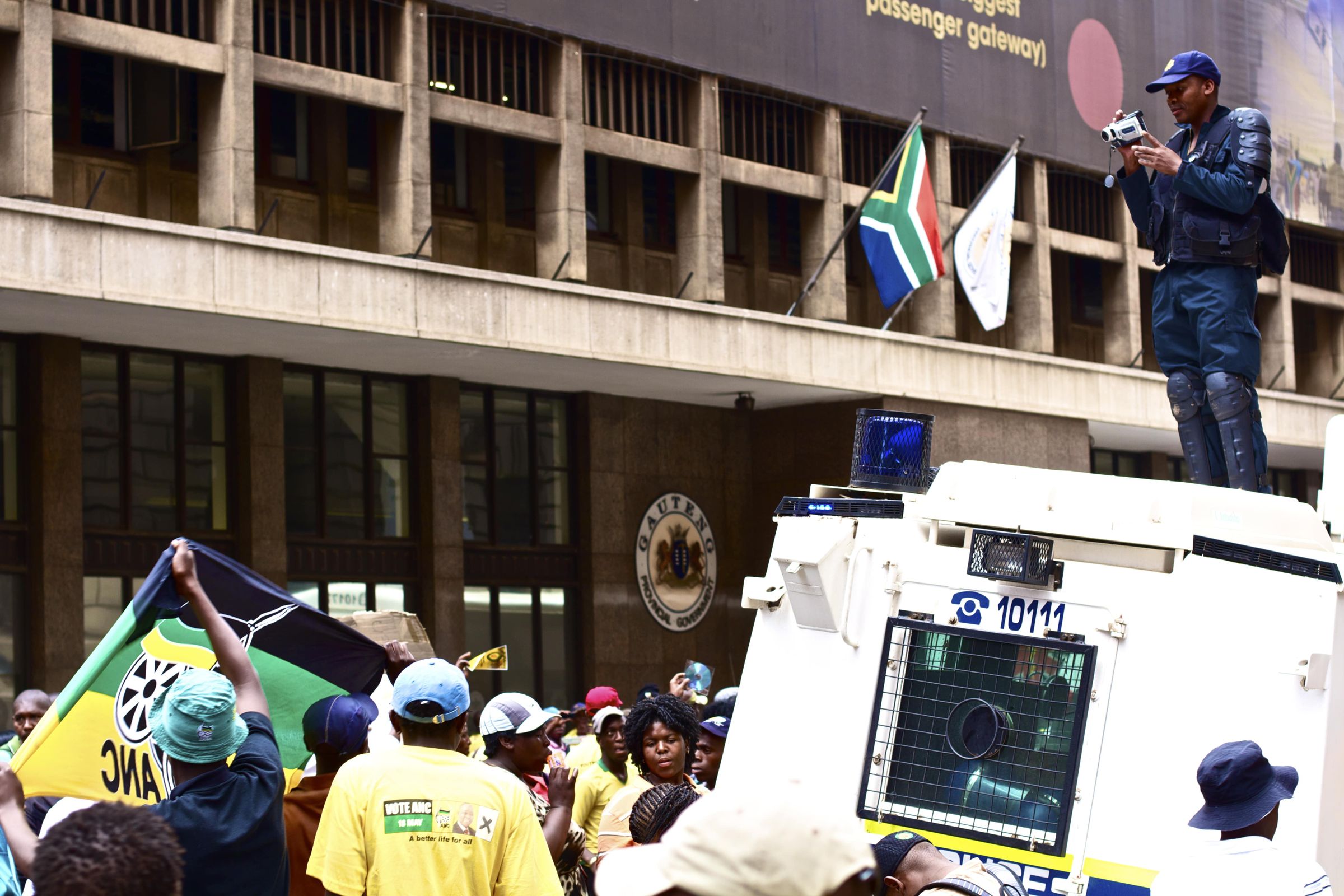
Rural Vote Reshapes South African Politics Beyond the Metros
Hung councils and coalition risk now dominate small-town governance
Eight metros, four in 10 South Africans, nearly all the analysis. Since Wednesday’s vote, market-watchers have focused on who governs Johannesburg, whether Tshwane holds its coalition, and what the MK party’s showing in eThekwini means for KwaZulu-Natal. Those are fair questions. But the other six in 10 South Africans live in secondary cities, small towns, farming districts and villages in former homelands, spread across 249 of the country’s 257 municipal councils. That is where the election did its most surprising work, and where the financial and governance consequences may prove hardest to manage.
The numbers from the provinces once called ANC heartland are stark. On the provisional ward ballot count, the party’s share fell from 66% to 54% in Limpopo, from 62% to 45% in the Eastern Cape, from 58% to 44% in Mpumalanga and from 55% to 44% in North West. In the Free State it dropped from 50% to 37%. Limpopo is now the only province where the ANC holds more than 50% of the vote. These are not metro numbers. Limpopo, Mpumalanga, North West and the Eastern Cape, outside its two metros, are overwhelmingly made up of small and rural councils. The ANC’s national fall, from 45% in 2021 to about 31%, cannot be explained by Johannesburg or Tshwane alone.
The effect on control is just as sharp, and it is here that the fiscal stakes come into view. Before the elections, the ANC governed about 105 local municipalities outright. By Saturday morning’s count it was on track to govern just more than 50. By the same point, 109 of the 175 councils already certified at the time of writing were hung, and most of those are not metros.
For two decades the conventional reading was simple: the ANC was losing the cities but could rely on the countryside. Rural voters were treated as a fixed quantity, a reliable base that cushioned urban losses. The 2026 election proved clearly that this no longer holds. Rural votes weigh, compare, and when credible alternatives are close at hand, they move.
Look closely and the rural shift is not one story but many, each shaped by place. In the former Transkei, voters turned to parties they know. The UDM roughly tripled its Eastern Cape vote and won 13 of 37 wards in King Sabata Dalindyebo. The PAC took 16% in Mnquma. The SACP, standing alone for the first time, won 6% of the Eastern Cape vote. In rural KwaZulu-Natal, the MK party became the largest party in eNdumeni at 32.6% and fell just short of outright majorities in Mandeni and uMshwathi. In southern Mpumalanga it overtook the ANC in eMkhondo with 41% to 34%. In North West, the ANC lost its majority in small councils such as Mamusa, where its share fell from 55% to 45%. In the Northern Cape, nine of the first 14 councils to finish counting by the time of writing were hung.
None of this came without warning. In 2021, local civic movements were already breaking through in rural towns. The MPAC16 Civic Movement took nearly 30% of the vote in Maluti-a-Phofung in the Free State. The Siyathemba Community Movement won almost 40% in its Northern Cape municipality. In Setsoto, a service delivery forum became the official opposition. Many commentators read these as purely local stories. In hindsight, it was early evidence that rural voters would back whoever they believed would fix their town. By-elections said the same: rural contests and small-town civics rarely make national headlines, yet they are often where a shift in loyalties shows itself first, because local voters judge parties on things they can see: water, roads, clinics and whether the councillor shows up.
Four reasons put the countryside at the centre of how this election should be read. First, it is where most councils are, and where the bulk of local government spending and services is decided. A collapse of single-party majorities in small councils changes how water, electricity and roads are managed for millions of people. Second, coalitions are moving into councils least equipped for them. Metros have large budgets and professional administrations that can absorb unstable coalitions; a small rural council with a thin staff and a narrow revenue base has far less room for deadlock. How these councils are governed over the next five years may matter more to residents’ daily lives than the next Johannesburg mayoral vote.
Third, rural voters decide national majorities. The ANC’s 40% in the 2024 national election rested heavily on rural provinces, and if that base is now divided, as it was on 4 November, the arithmetic for 2029 changes for every party. Fourth, rural politics shows what kind of alternatives voters want. In the cities, much of the lost ANC vote went to large national parties. In the countryside it often went to parties and movements with local roots: the UDM and the PAC in the Eastern Cape, MK in predominantly Zulu-speaking areas, civic movements in the Free State and the Northern Cape, the SACP in several provinces. That is a politics built on proximity and trust, and it will shape the coalitions that form.
None of this diminishes the metros. Their coalitions will shape investor confidence, and their failures in water and electricity are felt far beyond the city limits. But a national analysis built mainly on eight councils misses most of the country. Reading the election well means paying as much attention to a hung council in Makana or Mamusa as to one in Tshwane, and treating small-town civic movements and rural by-elections as evidence, not footnotes. The rural voter is neither a guaranteed base nor a passive audience, and the careful local choices now accumulating across 249 councils will decide whether the arithmetic of 2029 is already set in motion.
Q&A
How many councils were hung after the election?
By Saturday morning's count, 109 of the 175 councils certified at the time of writing were hung, and most of those are not metros.
Which provinces saw the largest ANC declines?
On the provisional ward ballot count, the ANC fell from 66% to 54% in Limpopo, 62% to 45% in the Eastern Cape, 58% to 44% in Mpumalanga, 55% to 44% in North West, and 50% to 37% in the Free State.
Which locally rooted parties gained in rural areas?
The UDM roughly tripled its Eastern Cape vote and won 13 of 37 wards in King Sabata Dalindyebo; the PAC took 16% in Mnquma; MK became the largest party in eNdumeni at 32.6% and led in eMkhondo with 41% to 34%; the SACP won 6% of the Eastern Cape vote standing alone.
Why do small rural councils face higher coalition risk?
Unlike metros with large budgets and professional administrations that can absorb unstable coalitions, small rural councils have thin staff and narrow revenue bases, leaving far less room for deadlock in managing water, electricity and roads.