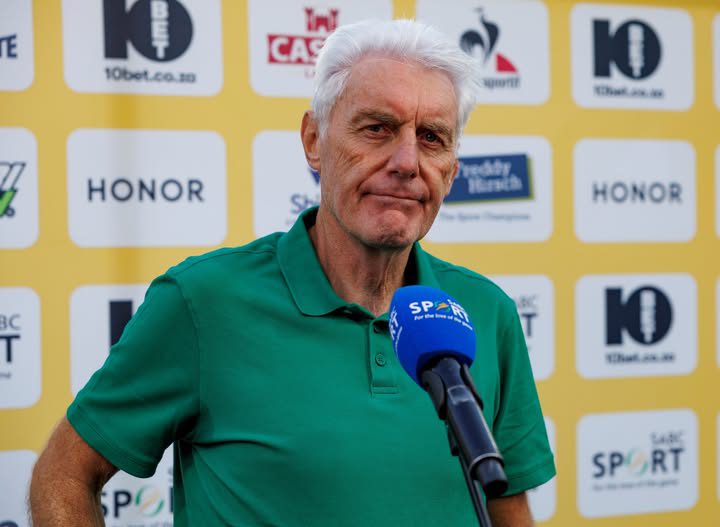
Hugo Broos has become the focal point of a growing national controversy after allegations of racism and sexism surfaced against the Bafana Bafana head coach, prompting a swift and forceful response from the South African Football Association (SAFA). The football body has categorically rejected the claims, describing them as unfounded and unsupported, while warning against the dangers of trial-by-public-opinion in an already charged social environment.
The issue has quickly evolved beyond football, drawing in political voices, social commentators, and online activists, and highlighting once again how sport in South Africa often intersects with broader debates about identity, transformation, and leadership.
The controversy around Hugo Broos emerged after remarks and interpretations circulated on social media and in opinion-driven platforms, suggesting that the coach had displayed racially or gender-insensitive attitudes. Critics pointed to selective comments and team-related decisions, framing them as evidence of bias.
However, SAFA has confirmed that no formal complaint has been lodged by players, officials, or any stakeholder through official disciplinary or legal channels. The absence of documented evidence has not prevented the issue from escalating into a public debate, amplified by the speed and reach of digital platforms.
SAFA moved quickly to defend Hugo Broos, issuing a statement that left little room for ambiguity. The association stated that:
SAFA stressed that it would never ignore credible claims of discrimination but emphasized that accusations must follow due process rather than public speculation. Officials warned that reckless allegations risk damaging not only individuals but also the integrity of South African football.
Hugo Broos has firmly denied the allegations, expressing frustration that his character and professional reputation have been questioned without evidence. According to sources close to the coach, Broos believes that some of his comments have been taken out of context and reframed to fit broader narratives unrelated to football performance.
Broos has reiterated that his approach to coaching is rooted in discipline, merit, and tactical balance. He maintains that player selection and team management decisions are based solely on form, fitness, and suitability for specific matches—not race, gender, or external pressure.
Supporters of Broos point to his extensive international coaching career as evidence contradicting the allegations. Throughout his tenure across multiple countries and football cultures, Broos has worked with diverse squads and backgrounds without prior accusations of discriminatory behaviour.
Since taking charge of Bafana Bafana, he has overseen:
Football analysts argue that his results-driven leadership has played a role in restoring credibility to the national team.
In South Africa, allegations of racism or sexism resonate deeply due to the country’s history and ongoing transformation journey. Even unverified claims can trigger emotional responses and political engagement.
The Broos controversy gained momentum because it:
This combination ensured that the story moved rapidly from sports pages to mainstream public discourse.
Reaction to the controversy has been sharply divided. On social media platforms, some users have defended Broos, accusing critics of manufacturing outrage for political or ideological reasons. Others have argued that leadership figures must be held to the highest standards, regardless of whether formal complaints exist.
Political commentators and activists have also weighed in, with some framing the debate as part of a broader struggle over transformation in South African institutions. This has further complicated efforts to keep the issue within a purely sporting context.
One of SAFA’s key concerns has been the potential impact of the controversy on the national team. With important fixtures ahead, officials are keen to ensure that players remain focused and insulated from external distractions.
Team insiders suggest that the squad has continued preparations as normal, with no indication of internal unrest. SAFA believes that public backing of Hugo Broos is essential to maintaining stability and confidence within the camp.
SAFA has emphasized that defending Broos does not mean dismissing the importance of accountability. The association reiterated that it has established mechanisms to deal with misconduct and would act decisively if credible evidence were presented.
However, SAFA warned against allowing social media narratives to replace formal investigation processes, cautioning that such trends undermine fairness and risk reputational damage without justification.
As things stand, there is no investigation underway and no indication that one will be initiated unless formal complaints are submitted. Hugo Broos remains fully supported in his role as head coach and continues to carry out his duties without restriction.
SAFA has called for calm and responsible engagement, urging commentators and the public to avoid inflaming tensions based on speculation.
The Hugo Broos controversy serves as a reminder of how quickly modern sports debates can escalate into national flashpoints. While the allegations have generated intense discussion, SAFA’s firm stance signals institutional confidence in the coach and a commitment to due process over public pressure.
For now, South African football leadership appears determined to keep the focus on performance, stability, and fairness—while navigating the complex realities of sport in a politically and socially charged environment.